Is your organisational chart lying to you?
Media advisor Selma Stern, who will be speaking at Congress 2026 explains why publishers’ biggest challenge may not be strategy, but the way they’re organised to deliver it.


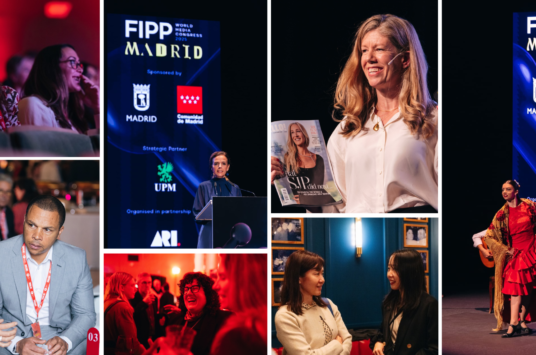
Selma Stern will speak at the FIPP World Media Congress, 13-15 October in Madrid, Spain
Many publishers are pursuing similar goals: growing subscriptions, diversifying revenue and working out where AI fits into their businesses. Selma Stern believes one of the biggest obstacles may be less visible: the way organisations themselves are structured.
Having worked at Boston Consulting Group, Axel Springer, Fortune and Business Insider before launching her own advisory practice, Stern now helps media leaders build organisations that can adapt more effectively. At Congress, she’ll argue that many publishers are still operating with structures designed for a much more predictable world.
We spoke to Selma about the hidden “Change Tax”, why the New York Times and Washington Post have diverged, and what publishers can learn from organisations far beyond media.
You’ve described the “Change Tax” as one of publishing’s biggest hidden costs. What do you mean by that?
Earlier this year, the New York Times posted record numbers while The Washington Post laid off a third of its staff on the same day. What struck me about that is that both companies are storied, Pulitzer-winning brands. They faced the exact same headwinds for decades. Arguably, they even have the same strategy: subscriptions and diversification.
Outsiders like me often point to billionaire ownership as the problem at WaPo, but I’d argue that there is a deeper, structural difference.
I coded publicly available employee reviews across 20 publishers. They describe the New York Times as a well-oiled machine. A bit bureaucratic, perhaps, but leadership is stable, the strategy is clearly articulated, staffers generally know who does what, and why.
In contrast, there are accounts of massive infighting at the Post, confusion about roles and responsibilities, and constant leadership turnover at all levels.
The “Change Tax” at the Post seems to be particularly high: the unnecessary energy it takes to get meaningful work done in an organisational structure that no longer supports the company’s goals.
You’ve also said the org chart is lying to most publishers…could you explain?
The traditional org chart suggests order and control over processes. I’m arguing that in the digital world, this notion of order is an illusion, no matter how much care went into aligning the boxes.
Take a print organisation in the 1990s: the newsroom made the journalism. When the newsroom was done for the week or the month, it handed the finished product over to the printing department. Then distribution took over, and so on. Work was sequential and mapped cleanly onto teams.
In the digital world, we’ve been trying to replicate these neat departments, but there simply is no right way to slice them. Product teams and journalists all think they’re making the product – and they are. Newsrooms, marketers, SEO teams and data engineers are all, somehow, co-responsible for distribution.
Crucially, most publishers feel like they just can’t get this right, and it’s only getting worse.
You’ve looked outside publishing for examples of organisations built differently. What have you learnt?
Companies like Bayer and Palantir run on dual hierarchies, however imperfectly.
Palantir’s forward-deployed engineers do their day-to-day work on client missions, reporting to mission leads. At Bayer, “Dynamic Shared Ownership” means flexible teams come together with full execution power for a specific objective, then disband once it’s complete.
Interestingly, organisations as different as consulting firms, film production companies and the military have all used versions of this mission model for a long time.
When the problem space is ever-changing and the solution space is stable, that’s the best way to organise.
I’m arguing that a news media company’s problem space used to be predictable, and now is as volatile as any in an AI-first world, so we need inherently flexible organisations.
How has advising from outside changed your perspective?
Empathy, I hope! I know what it feels like to be responsible for millions in revenue and dozens of teammates in an organisation with ever-changing, complicated power structures. BCG is where I learned the consulting craft.
Now, in conversation with CEOs, I can challenge their whole setup, their whole operating model. When you’re part of an organisation, you might see the flaws in its architecture, but it may or may not be in your team’s interest to call them out.
What’s the one question you’d like media leaders to leave Congress asking themselves?
Am I losing my best people because of soul-sucking alignment rituals?