The Economist’s Daisy Donald on taking journalism into the workplace
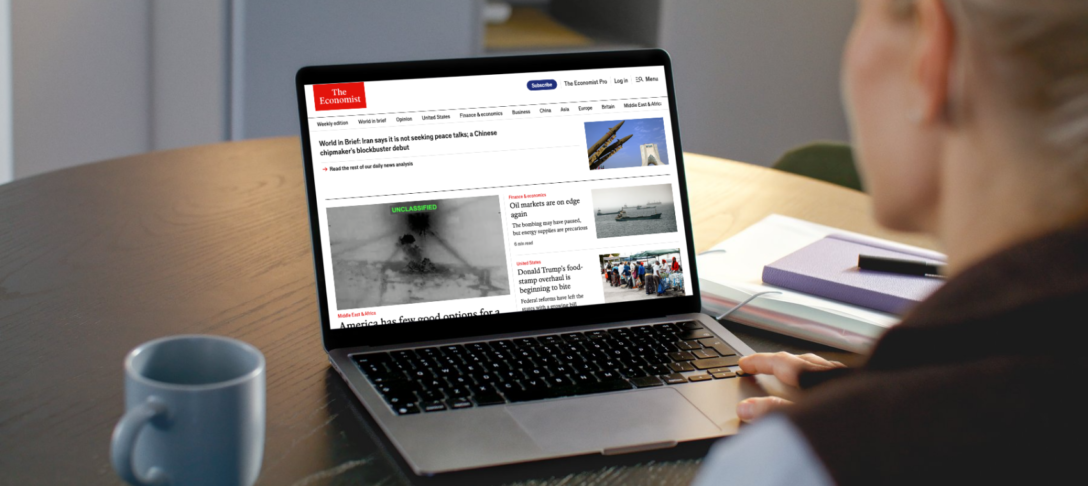
At FIPP World Media Congress, The Economist’s head of propositions will discuss corporate subscriptions, AI workflows and how publishers can stay valuable when journalism is consumed beyond their own platforms.
The Economist’s journalism is written for a broad readership. But when organisations buy access for thousands of employees, the question changes: how do you prove the value of journalism designed for everyone to people with very different jobs?
As the head of propositions for The Economist’s corporate subscription business, that challenge sits squarely on Daisy Donald’s desk. Her job isn’t to change what The Economist publishes – editorial keeps tight control over that – but to work out how journalism built for a mass consumer audience can be packaged, priced and proven valuable enough that a business will pay for the whole organisation to read it.
That tension is at the heart of Daisy’s work: “We’re selling group subscriptions to economist.com, but ones that are for organisations.” The Economist’s journalism is valued precisely because it is selective, analytical and global in outlook. But when a business is buying access for a whole organisation, the sales case has to be made in more practical terms.

Daisy Donald will speak at the FIPP World Media Congress, 13-15 October in Madrid, Spain
The work, she says, is about “really understand[ing] the value proposition in different industries and for different personas within those industries” and giving the sales team the materials they need to make “a good… persuasive argument as to why they should purchase The Economist content or to integrate into their AI systems.”
The Economist recently brought its commercial divisions together under Economist Enterprise. Daisy’s team sits somewhere between consumer subscriptions and enterprise sales.
Learning to move at (B2B) speed
From her career on the consumer side – including time at the FT, Reuters and FT Strategies – Daisy has brought a discipline around data that she says is less common in B2B businesses by default. A consumer subscription business sees the impact of a change within a day. A corporate sale can take much longer. “It takes six months, really, to make that pay off,” she says, “and you’ve got to do that over and over again, every day.”
That makes the work slower to prove, but important to get right. Daisy describes bringing over two habits from the consumer subscriptions world: using data well, and being willing to change direction when the evidence says something is not working.
Her response has been to bring over a test-and-learn instinct from the consumer world rather than defend any one approach indefinitely. Her team recently abandoned a commercial model for one of its products – a model she herself had set. “I’m not precious about that,” she says.
The bigger question: who else wants the content?
But the bigger question Daisy is grappling with sits outside The Economist altogether. A growing number of large organisations – consultancies prominent among them – are building their own internal large language models trained on decades of proprietary work, then licensing content feeds from major outlets, including The Economist, to add external market context.
A growing number of organisations are building internal AI tools and licensing trusted external content to add context. For publishers, that creates a new balancing act: making journalism available where customers already work, while ensuring their own platforms remain valuable destinations. “Whilst we are working to ensure our customers can experience our content in the systems they already use, we need to continue to make economist.com a great place to experience it too.”
Making relevance more visible
The Economist has historically maintained a strict line around creating content specifically for Pro users. Daisy’s team has just crossed it, launching the title’s first ever Pro-only newsletter. “There was always a belief that we would never have Pro-specific content,” she says. “We’ve broken our rule now with this dedicated newsletter, so we are looking forward to seeing the results.”
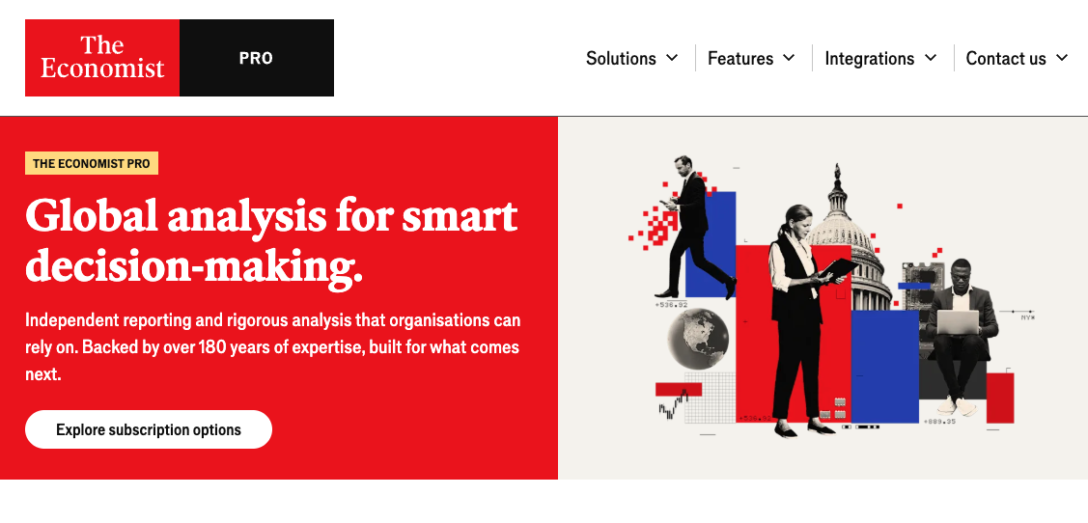
The same thinking sits behind a new homepage for Pro users, designed to show more clearly which Economist stories are most relevant to business readers, also due to be rolled out to all Pro users in the coming months.
Underpinning all of it is the belief that the answers to most of these questions come from talking to the people actually making the buying decisions, not assuming them. “You can’t talk to your readers enough,” she says.